If there were a way to scientifically measure cultural transformation, China would be off the charts. The velocity of development (or rather, of change) is inconceivably high in nearly every domain: economic, cultural, linguistic, social, and even physical. The immediate analogy for the change of the cultural landscape is the famous Chinese urban landscape. Urban space changes daily: new skyscrapers appear almost overnight, construction being a 24 hour endeavor; roads are changed and subway lines are added, so even the flow of bodies is in flux; and even the air is changing, as government initiatives to reduce pollution before the Olympics brings hints of blue sky behind low-hanging grey smog.
The rate of change is such that by the time any observation is committed to paper, it might well be obsolete. It is thus a daunting task to attempt any stable calculation or fixed analysis of China. As methodologies go, Cartesian thinking will not go far; China almost requires Chaos Theory.
But the Western media overplay the notion of chaos in China. Readers of the NY Times are encouraged to see China as a developmental anomaly, a third world nation so eager to develop that it is bursting at the seams with novelty, change and movement. What Westerners fail to understand is that this sort of chaos is deeply embedded in Chinese society, which historically has maintained the counterintuitive combination of a militant bureaucracy with intermittent, almost constant, social upheaval. Given that the present moment is the fist period in the last century when China has NOT been engaged in some sort of revolution, this chaos can be considered relatively stable.
What Western media is calling chaos is in fact inconsistency, but these are not the same thing. Whereas in the West a cell phone retains connotations of bourgeois excess (owing to its genesis in the 1980s yuppie boom), in China the cell phone has become a champion product of nearly every class. Though seeing a poor migrant worker in tattered clothing chatting on his cell phone might be jarring to Western eyes, this reaction wrongly projects a Western reality onto a Chinese one. No wonder the result appear surreal; it is superimposed. China is piebald, but not fragmented, in flux but not in chaos. To risk sounding like an orientalist, perhaps a Daoist notion of impermanence and change is the best way to understand China....
Social networking is a staple of Chinese culture, and has been for thousands of years. “Guanxi” as it is known, is the notion that everyone you have a relationship with is conceived of not simply as an acquaintence, but as a potential ally in the ongoing struggle to overcome the inevitable obstacles on the road of life. In the West, this kind of networking is reserved for business people or social arrivistes, and connotes a cut-throat and even tactless attitude. However, this connotation comes from the West, where we are raised with the idea that one person can accomplish anything. Yet there are 1.3 billion people in China and as one young professor told me, “Who needs 1.3 billion individuals?” Chinese “guanxi” is a tacit recognition that in the face of a massive totalitarian bureaucracy or a cut-throat emerging marketplace, one person cannot get very far at all. Guanxi is the product of a collectivist society; networking is a way to magnify individual agency by forming an aggregate network-agency, a quiet subversion of an unfriendly reality.
This is relevant to cell phone use especially because it explains away much of the confusing cell phone culture. The first reaction to almost any obstacle is a phone call. If there is trouble with paperwork, one calls a friend who calls a friend, etc. Email is, in many ways, too slow, and text messages convey less urgency. Cell phones allow for real-time access to the Guanxi network, which is more relevant to Chinese lives than the internet and its networks. For example, while French taxis now use GPS machines (Tom Toms) to find any location in Paris, a Chinese taxi driver, when confronted with an unknown address will simply call a friend (or fellow driver) and ask. A pedestrian might well do the same to find a location, or call the destination ahead of time.
For Chinese youth, there is another dimension to networking that is less related to Guanxi, and that is the need for social and emotional connection. Thanks to the one-child policy, China has created a generation of only-children. Aside from being famously spoilt and demanding (the so-called “little emperors” that result from being doted upon), these only-children are often very lonely. Home life is full of tremendous pressure, because as only-children, the successful continuation of the family name and the financial future of the family rest entirely upon their young shoulders. While doted upon and often rewarded with gaudy material gifts (when they succeed), these kids seek release from the tumult of parental expectations in new forms of social activities.
Cell phones are the best thing to happen to teenagers worldwide. Not considered frivolous or luxurious as in the US, cell phones are a basic commodity for all age groups, but for teenagers they allow constant contact with a social world even when they are at school, in transit, or even at home studying. Not only can they be used to make plans, they are an activity in and of themselves: American cell phone calls are often short and to the point, leading up to a face to face meeting, but Chinese cell phones allow for endless frivolous chatting (“liao-tian”) which is a favorite pass-time of all Chinese.
Thursday, September 13, 2007

Sunday, May 20, 2007
Everything is Illuminated Manuscripts
V.S.
:-)
:-)
Everyone is always talking about the internet, and like Jan Brady memorably complained ("Marsha, Marsha, Marsha!") I feel I must say something. A friend of mine has dropped the article and calls the internet simply "Internet," as if it were a proper name reflecting the intimacy one has with the web. "Let's ask Internet what the weather is like in New York," or "Internet gave me directions to your house." This is funny to me, so I'm going to do the same.
But in the past few years, what could be called the puberty of Internet, in all its awkward glory, makes for a very interesting linguistic moment. What no one seems to talk about is the newly priveleged status of typing . We type to enter passwords, write e-mails, use keys and a mouse to navigate this mystical and epic interweb space. Everyone, however, is focusing on the space we access, not how we get there. I have a vested interest in buttons as an interesting icon of human-machine interaction (for a later post) but for now let's talk about typing and it's effect on language and psychology.
We've seen the efficient reduction of language into alphanumeric abbreviations, e.g. c u l8r, h@Rdc0R3, omg, ROFLMAO (side note: I don't think "Rolling on the floor laughing my ass off" was a popular idiom before Internet came along) etc. Then the collective libidinal investment in typed symbols manifested itself in the now iconic smiley face, :-), and the myriad other emoticons which followed.

The same symbols were available to scribes and printers hundreds of years ago...did they not see the simple face in a colon, hyphen and end-parethesis? They weren't stupid. They probably were just not interested in anthropomorphizing text. But medieval illuminated manuscripts say otherwise. The above illuminated capital from the Florentine Visconti Book of Hours (started by Giovannino de'Grassi and completed by Luchino Belbello da Pavia, image courtesy of Columbia.edu). The marvelous illustration takes the first capital letter, "O" as a frame for the creation of Eve in the Garden of Eden. Aside from beautifying the Biblical text of manuscripts, this art technique also proved as a source of distraction for the otherwise mind-numbing task of copying sacred text over and over and over. Much has been written on the strange monsters which appear in the margins of these texts; some say they are simply playful illustrations, others point to obscene examples as steam vents for the scribes, while still others say they reflect the haunted psychology of the Middle Ages. For now, suffice it to say they are abberations.
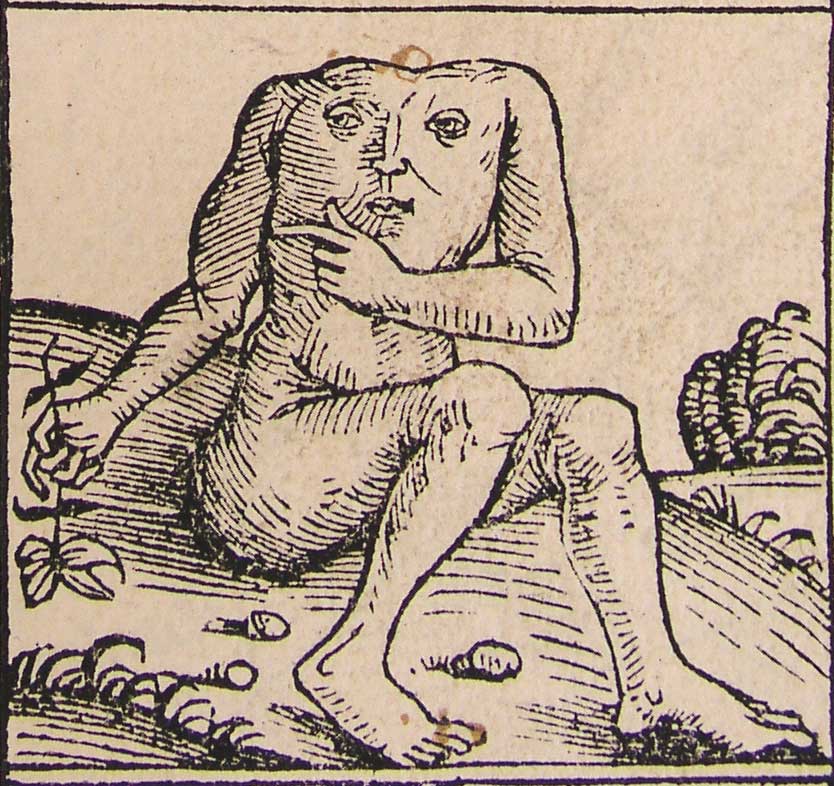
This monster, called a Blemmye, is a headless creatur with its face in its torso. It probably is the result of crusaders encountering warriors with faces painted on shields. He looks like a grotesque incarnation of the smiley face. Isn't he the ultimate emoticon?
Finally, I just wanted to mention a final abberation in our discourse with Internet: Spam. The poetics of Spam, which displays both the most absurd language in circulation (slogans and ads and nonsensical words) and the most calculated language (to avoid filters, to appear as language). Years ago, Spam was mostly ads for pornography, penis enlargement, dating services, etc. Then came the bogus bank inheritence claims (many of which are said to have originated in Nigeria) and real estate or stock market tips. Starting with Viagra, the sale of prescription drugs has also dominated Spam space. Ambien, Xanax, Vicodin, Percocet...that these are being hocked to the average internet user shows the national trend toward pill-popping.
But the most interesting phase is right now, with the unsettling nonsense of the fake-friend e-mail, designed to look like a reply to an e-mail you might have sent. Here are some the best ones (all real, I swear):
Re: anything miser
Re: bravado norms
Re: on heraclitus
Re: phthalate computer
an e-mail address
nullstellensatsz Rickey
Your help on a new project?
I to maricopa
colombo discover
She died saving all of us.
Re: precipice f
At before boerne
you do martel
Re: be thrall
or Sync
Re: I checkup
The content of these e-mails varies, but here's a pretty typical example:
"This one is shoe in to Double by end of week
Huge Volume spike, many people are already in the know
Imagine getting in on next HANS or FIZ
Fire Mountain Bev Company
SYm-FB VG
Extremely b ullish at 2 Cents
This is projected to go to $.70 in short alone, for long look at HANS and FIZ
Remember Snapple, this will be bigger
Get in Tuesday don't Miss it again
People are already loading up, you should too!!
cohesion because of injuries, illnesses, trades and suspensions. The Nuggets championships and we haven't been close to doing either in a lot of ways." points - since their 129-127 double-overtime win at Dallas on Wednesday night. handle when Anthony and Iverson are coming at you like that. They are hard to"
I'm not going to do a close reading of this, but what kind of language are we looking at? It's like a stock broker's stream of consciousness free-writing.
Oh brave new Internet...
Thursday, April 26, 2007
India: Where Holiness and Contempo-Casual Unite

Blogging at you from Goa, India, former seat of the bygone Rave empire. High-season is over, but the dusty streets are still filled with merchants desperately trying to pawn off the remaining neon sarongs, Mother Teresa t-shirts (no, really) and sandalwood bongs, to the red-skinned middle-aged Brits trolling for cheap exotica.
Too hot for insight, Goa is thankfully less of a cultural center than a half-empty resort city. Don't get me wrong, we're enjoying ourselves here. It's a relief to see Indians in denim, open shirts and tank-tops...in other words, it's nice to see locals dressed as tackily as we are. There are saris for some, but the Portugueuse presence makes itself felt in the predominantly Catholic populace (and the colorful cathedrals and houses). So Hindu taboos don't register here, as can be seen by the tank tops sporting Shiva or Durga. These fill every shop on the street. I am puzzled by why an Indian would sell such things, but I suppose tourist markets dismantle the ethics of indiginous culture pretty quickly. Also, like I said, most of these people are Catholic. I can only imagine what a devout Hindu would think about seeing the face of God stretched over a hefty tourist's enormous, sunburned breasts. Probably something along the lines of, "Wow, I hate these fat sons of bitches."


Friday, March 16, 2007
I Like China a Latte

China is insistent, even, or especially, in its inconsistencies. But these holes in the narrative of everyday life give you the opportunity to fill them in with whatever back-story you like.
If you like starting your day with a fresh cup of coffee, China might not be for you. But if you're like me, and what really gets you going is not caffeine but rather a piping hot paradox, then book a flight to Shanghai right away. Sitting in a sprawling two-floored coffee shop, I cannot help but admire the sleek, nostalgic décor: marble and wood floors, velour chairs of deep grey and brown, embroidered pillows and large plush peppers hanging from the maroon and gold walls. The lacquered ambience falters when I look up at the exposed pipes and vents overhead, yet the determined splash of the electric fountain and the soft Mandarin-pop ballad playing on loop seem to demand my calm like some horrible lullaby.
For those unused to normative relaxation, it can be difficult to feel at ease among so much stimulus. Here at Shanghai UBC Coffee, my cup runneth over. With everything except coffee. There are twice as many service people as customers, but it's been ten minutes since my attentive waitress diligently took my order (a cup of Blue Mountain Superior) and although she ran to deliver my order with an urgency usually reserved for medical emergencies, when she reached the young barrista (who was wearing a red tuxedo), I did not detect any activity or indication that my coffee was, in fact, being prepared. Maybe they went to grind beans out back, or maybe they sent someone to Blue Mountain to seek out a fresh batch. When I looked over to the waitress with sad, thirsty eyes, she smiled sympathetically but doesn't budge, shrugging slightly as if to say, "It's out of my hands."
While I wait, I imagine the barrista climbing Blue Mountain in his formalwear, wrestling tigers and riding pandas to reach a the craggy mountaintop. After climbing one thousand wooden steps, he reaches a jade temple situated on the foggy peak, and after slipping off his shoes, he gingerly walks down the echoing halls and reaches a shrunken old man with long wisps of white hair dangling purposefully from his miniscule frame. One can sense that he is as old as time itself. The young barrista kowtows, avoiding eye contact with this great sage. Grunting in approval, the old man bellows "Why have you come to the Great Monk of the Jade Temple atop the treacherous peak of Blue Mountain?" The barrista shakes, acknowledging the rarity of an audience with such a powerful individual. "Great Monk of Blue Mountain! I come to you from one of Jade Temple's noble subsidiaries, Shanghai UBC Coffee Ltd. A customer has ordered a cup of Blue Mountain Superior, but our storeroom has run out. I come to humbly ask that you, in your Infinite Wisdom and Compassion, prepare a cup for me to take back." The Great Monk listens earnestly, winding the long white hair that protrudes from a massive mole on his chin around his finger, until it is entirely covered, then lets all two yards of hair drop slowly into his lap. He repeats this gesture several times, and then finally speaks. "Rise, young barrista of the Red Tuxedo. Although it is against store policy for me to brew precious Blue Mountain Superior coffee on any day except a lunar eclipse, I will forego the proper ritual because you have shown tremendous courage in coming here. Your devotion to service is commendable, and so I shall do as you ask." The Great Monk extended his short arms in front of him and balled his right hand into a fist, opening his left palm beneath. Murmuring a secret chant under his ancient breath, the Great Monk's person became engulfed in a bright blue flame. The blue light filled the room with such intensity that the young barrista shielded his eyes, but even with his eyes closed he could feel the flame's hot, primal power. A loud whirring sound erupted from the Great Monk's fist, struggling occasionally like a coffee grinder encountering a particularly tough bean. Out of nowhere, a grey cup materialized in his palm to accept the boiling brown liquid trickling from his fist. As the blue light faded, the barrista looked up nervously. The Great Monk offered forth the coffee and smiled slightly. "The deed is done." The barrista began his effusive thanks, but the Monk interrupted, "There is no time, child! Now make haste, lest your parched customer think ill of Shanghai UBC Coffee Ltd., or its parent company Blue Mountain Jade Temple!" With the cup and saucer in hand, the barrista took his leave and raced down the mountain, spilling nary a drop of the mystical beverage. Rushing through the back door of his familiar workplace, he returned to the coffee bar and gingerly set it on the counter. As he hit the tin bell to announce the order's painstaking completion, a triumphant smile spread across his young face. Perhaps, just perhaps, he had proven himself to be a barrista worthy of his red tuxedo.
At least, I like to think that's why my coffee is cold.
Wednesday, February 14, 2007
The Hippest Thing Since Sliced Pelvis

As sophisticated design pervades every facet of today's visual experience, the world seems sleek and stylized, from screen-printed t-shirts to wall-paper to stationary to the walls of the Whitney. But this aesthetic is not so hard to conjure up. It is aggressively stylistic, bohemian but bourgeois, and constantly alluding to some political or social commentary. Susan Sontag wrote that "design is mute," and so mistaking an Arab kaffiyeh scarf for a fashion accessory is effectively silencing the ur-culture and its aesthetic.
So here are some quickly conjured up hip images, done in just a few minutes each. Not that I am not proud of these silly things (the 2nd one done with kuso.net, the others by yours truly) but....it's easy, try it!


Less than three (<3)

This won't be a cynical Valentine's day post, but a few thoughts on hearts.
The best story is, in my opinion, Hanuman, the Hindu Monkey God. Here's the story:
Once Sita gave Hanuman a necklace of pearls. After a while, the residents of the city observed him breaking the necklace and inspecting each pearl minutely. Intrigued they asked him the reason. "I am looking for Rama and Sita," replied Hanuman. Laughing at his apparent naivety the spectators pointed out to him that the royal couple was at the moment seated on the imperial throne. "But Rama and Sita are everywhere, including my heart" wondered aloud the true bhakta. Not understanding the depth of his devotion, they further teased him: "So Rama and Sita live in your heart, can you show them to us?" Unhesitatingly, Hanuman stood up and with his sharp talons tore open his chest. There, within his throbbing heart, the astonished audience were taken aback to find enshrined an image of Rama and Sita. Never again did anyone make fun of Hanuman's devotion.
Above is a more traditionally executed image, and here's a more popular version of the same scene:

Althought it's a Hindu story, Hanuman is in some ways the ideal Jewish son: devoted to Ram and Sita...and also a heart surgeon!
By comparison, I find the Christian Sacred Heart less exciting.

Wednesday, February 7, 2007
Rollin' Barthes

This photo is of Lewis Payne, a conspirator in the Lincoln plot. He is handcuffed and awaiting execution. A somber occassion indeed, so why does his disaffected patina make me think of high fashion photography? It's by Alexander Gardner (1865), who also did Civil War photographs, some of which have a similar macabre eroticism. Roland Barthes recognizes a homoerotic element in this image; is it his resignation to death, his captivity, or the eye-contact with the viewer, an expression of neither regret nor fear...?
Let's compare and contrast. Below is a recent photo by David LaChapelle of Paris Hilton called "Class Struggle."

Aside from the obvious differences between the two images -- the colorlessness and hyper-pigmentation, the sincere and ironic intentions of the photographer -- both show celebrity in chains. Lewis Payne's infamy is of a different order of magnitude that Paris Hilton's , but both are characters reviled enough to be photographed. What interests me is the different gazes. Payne, as noted above, is unsettling precisely because he is aware of his fate but indifferent, whereas Paris, who is not renown for her insight, does not seem aware of the satirical and hyperbolic character of LaChapelle's project. (Just see how other celebrities are more visibly "directed" by LaChapelle). The image signals the entrapment of celebrity and iconicity, but just as Payne shows no regret for his murderous collaboration, Paris is unapolagetically vapid. She is her own caricature, and like the criminal behind bars, is untouchable, however condemned.
For a fantastic insight on Paris Hilton and the American psyche, check out Kay S. Hymowitz's "The Trash Princess."


Subscribe to:
Posts (Atom)